
Find where technical debt is actually costing you time.
A CLI that crosses Git history, code complexity, and authorship to surface hotspots, coupling, knowledge risk, and a refactor plan — before the interest compounds.
curl -fsSL https://getokulo.dev/install.sh | sh
macOS & Linux. Windows:
PowerShell one-liner.
Then run okulo --help.
- 01Analyze in the terminalHotspots from Git history in seconds.
- 02Launch
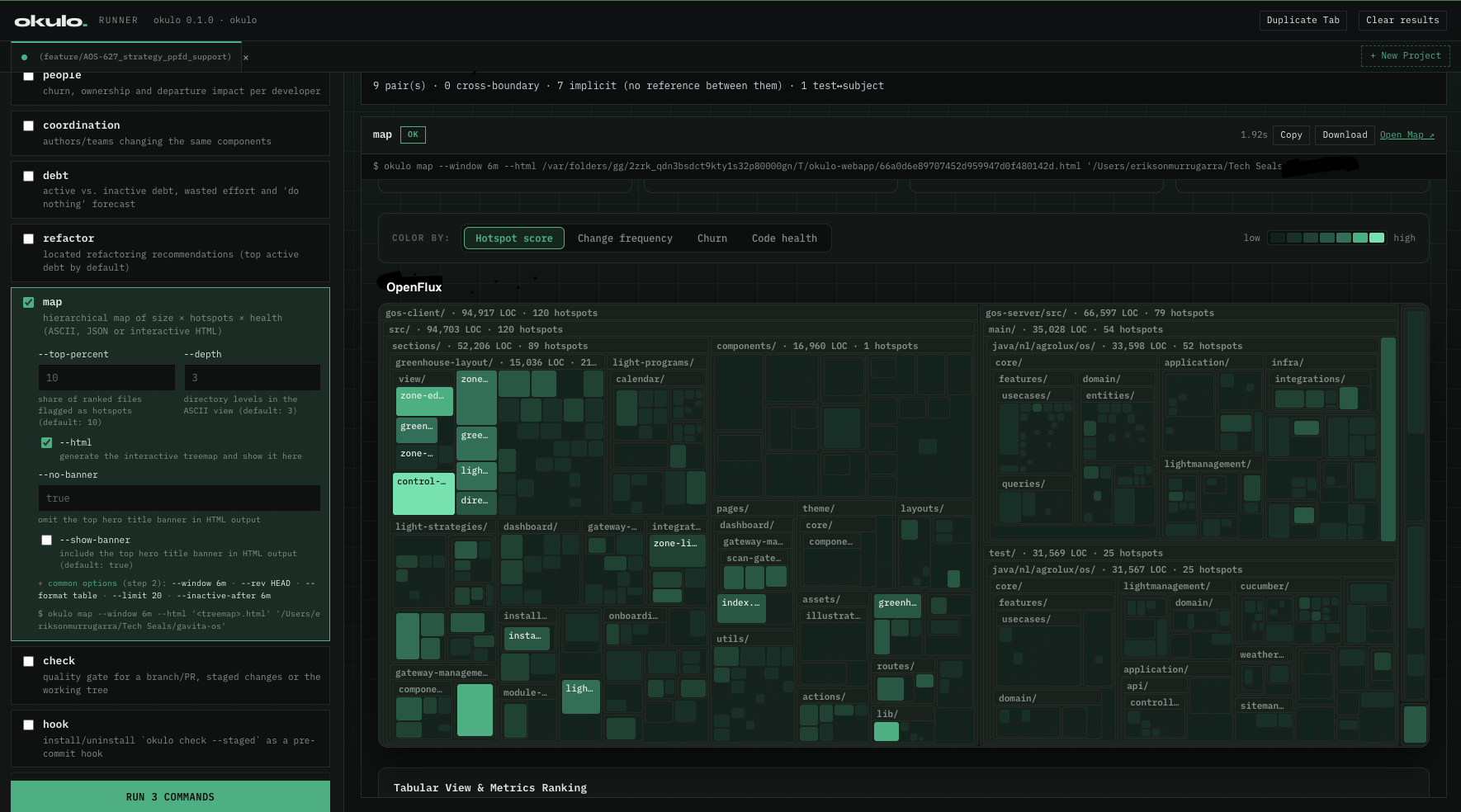
okulo webSame reports, served locally. Docs → - 03Explore visuallyPick commands, tweak flags, drill into the map.
What Okulo answers
Static analysis sees structure. Okulo adds change and people — so you prioritize the debt that is collecting interest.
Hotspots
Complex code that also changes often. That is where cleanup pays back.
Temporal coupling
Files that move together without an explicit dependency — hidden architecture.
Knowledge risk
Ownership islands, bus factor, and coordination pressure across components.
Known CVEs
Scan lockfiles (npm, Maven, Pub) against OSV.dev — only package names and versions leave your machine.
Commands
Run any command in a Git repo (or pass a path). Full reference in the docs.
Examples, flags, and a full team workflow → Commands documentation.
Windows
PowerShell (current user PATH is updated automatically):
PS C:\Users\you> irm https://getokulo.dev/install.ps1 | iex
okulo
See the code that is costing you time.